

Do you want to know about the latest blockchain and digital assets development in Africa? You can have this newsletter sent to your inbox every Saturday.
Crypto’s biggest development of 2023
Mariblock
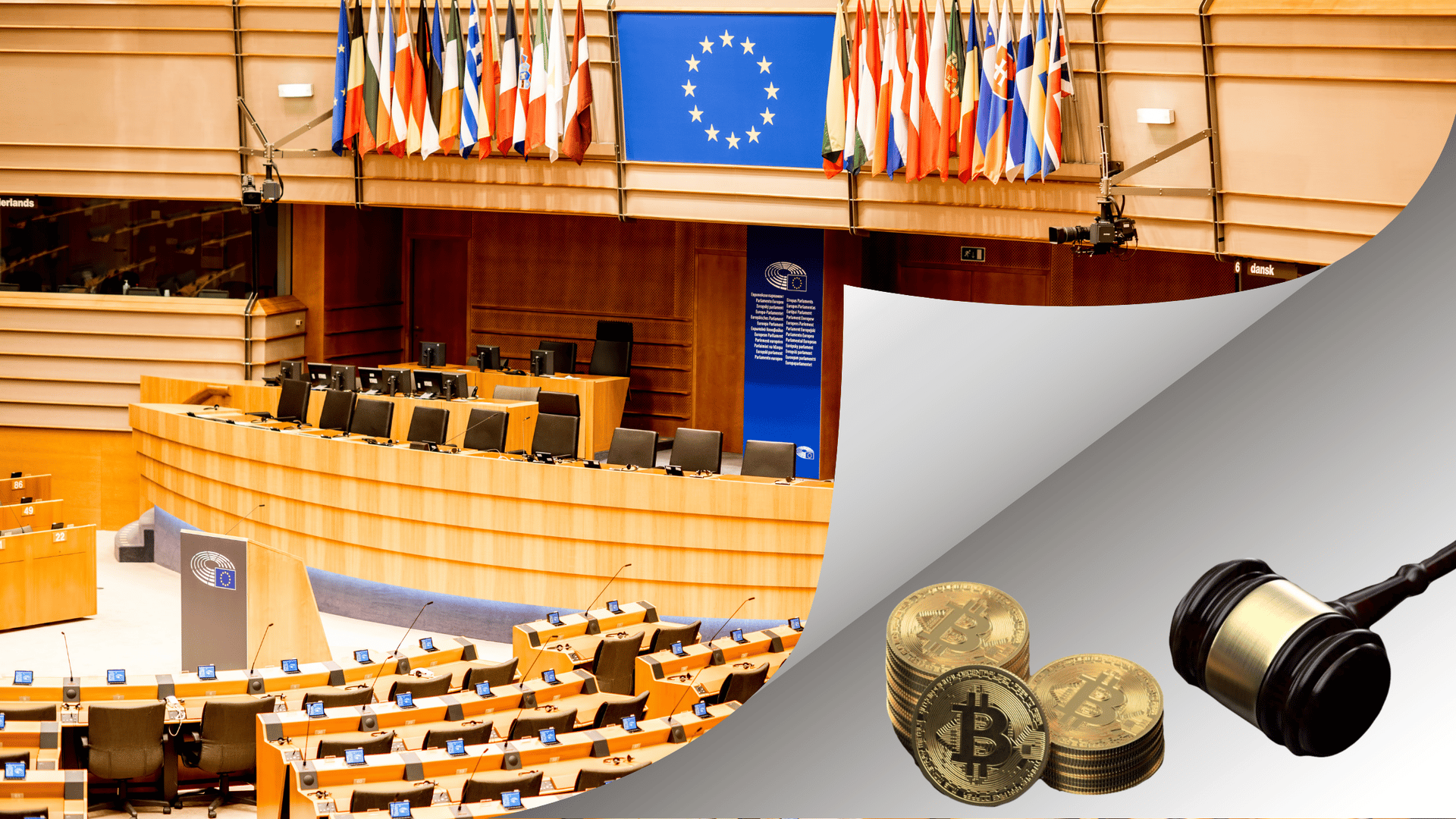
The big news: On Thursday, the European Union (EU) became the first major global jurisdiction to introduce a comprehensive cryptocurrency law.
- EU lawmakers voted overwhelmingly in favor of a new licensing system called “Markets in Crypto-Assets” (MiCA), which would now mandate exchanges and wallet providers to obtain a license.
- In addition, MiCA requires stablecoin issuers to hold appropriate reserves.
Why it matters: The events of last year, including the demise of the algorithmic stablecoin Terra, and crypto exchange FTX, severely damaged trust in the crypto industry.
- What has followed is a raft of controversial regulatory actions, particularly in the United States, where exchanges are being served all sorts of notices.
- There have been talks of a coordinated attack on crypto by the U.S. government.
Of note: some companies, such as Bittrex, are closing their U.S. operations. Coinbase is reportedly prepared to exit the country if it must.
- There have also been accusations of the U.S. government capitalizing on the failure of American banks Signature, Silicon Valley Bank and Silvergate to de-bank crypto companies.
- Given the importance of American money in the crypto market (the country received nearly $1 trillion in crypto value between July 2021 and June 2022), the U.S. government’s action has been causing tremors globally.
A new lease on life: By passing a crypto bill, the EU is giving the industry a chance to innovate and build trust again while, importantly, keeping consumers safe.
The African picture: We’ve heard a few African regulators, particularly the Nigerian central bank governor, saying their decision against supporting crypto aligns with most top regulators worldwide.
- That line is being made redundant with every new regulatory clarity worldwide. More countries would look at the EU and say, “We have to take this sector seriously.”
- It should be said that a few African countries are already moving to provide regulatory clarity.
- Notably: South Africa is undoubtedly the pacesetter, having asked banks to offer services to crypto companies. The country’s anti-money laundering watchdog also added crypto businesses to the “list of accountable institutions.”
- Lawmakers in Nigeria and Kenya are reportedly working on crypto bills too.
Still on regulations: Zambia is also racing to produce a regulatory framework for crypto.
- A Reuters report citing Technology and Science Minister Felix Mutati says the country will complete tests for its crypto regulatory technology by mid-year.
- Mutati said the tests would help the country develop regulations promoting innovations and protecting citizens.
Finally, on policy and regulation: The government of Lagos State — Nigeria’s Silicon Valley — is considering including blockchain education in the curriculum of state-owned schools.
- This is the second blockchain promise the Lagos state government has made in 2023. Governor Babajide Sanwo-Olu, as part of his re-election campaign, vowed to make the state “a home for blockchain innovation.”
From the African blockchain business scene

Ifeoluwa Awowoye; Freepik
We start in Nigeria, where the investors of the recently sold crypto payments company Fluidcoins are set to recover some of their money back.
- Fluidcoins got sold to Bitnex in February after it failed to secure funding.
- At the time of the sale, controversies arose as to whether investors knew about the decision to sell the company and if their funds would be recovered.
- Progress: Per a Techcabal report, all investors were called in for negotiations a few weeks after the sale and were offered a portion of their initial investment.
Elsewhere: South Africa-based Standard Bank and CV VC, the investing arm of the Swiss venture builder CV Labs, released the second edition of the Africa Blockchain Report this week.
- By the numbers: African blockchain companies raised $474 million in 2022, representing a 429% year-over-year growth, which, the report says, is the highest of any region globally.
- But as indicated in our coverage, the adopted methodology is questionable.
- Case in point: The report classifies global cryptocurrency exchange KuCoin and the Ethereum scaling service Scroll.io as African companies merely because they’re registered in Seychelles.
- This lacks the context that KuCoin and Scroll became African companies because they found a regulatory haven in Seychelles. Neither of these companies is African-founded. They also do not earn most of their revenue from the continent.
- Translation: Excluding funds raised by Seychelles-registered companies, the total funding figure for 2022 would be $265.96 million.
Blockchain in banking
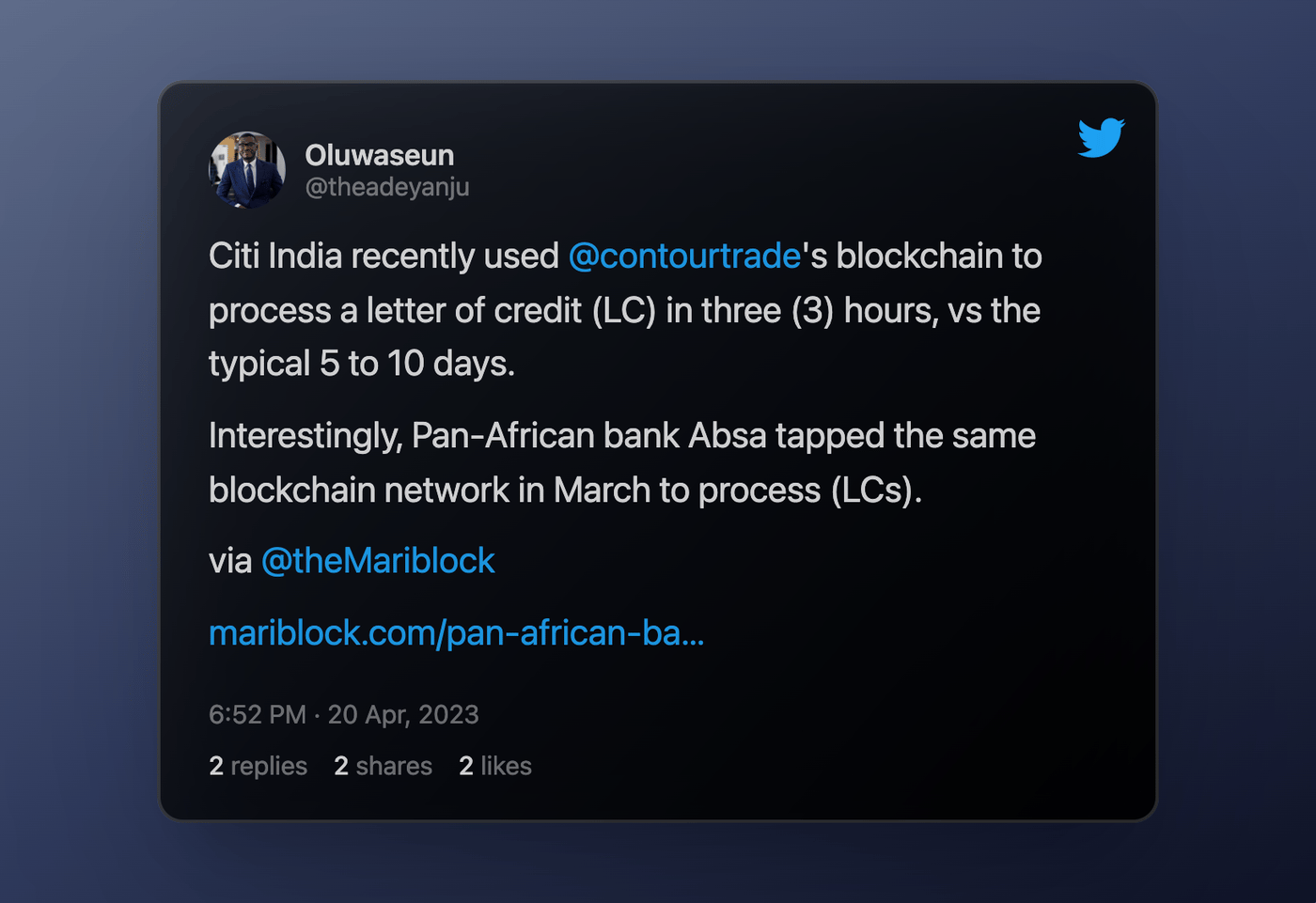
From Oluwaseun: I habitually scroll through LinkedIn to find the latest developments in our fast-paced industry. It’s almost like there’s something new every day. I stumbled on a post from the crypto media outlet Blockworks about Citi India. There’s an African angle here.
- Top line: Citibank, India, used Contour’s blockchain for trade to process a letter of credit (LC), a standard payment instrument in international trade.
- A letter of credit is a written undertaking by a bank to guarantee that a seller will receive their payment on time and for the agreed amount in an international trade transaction.
- Of note: “Contour’s decentralized global trade finance network has proven that LC processing time can fall by as much as 90%,” Citi wrote in a press release.
- “Under the LC, document presentation usually takes 5-10 days, while for [Citi’s client] Cummins, it was completed in three [3] hours.”
The African angle: Just last month, pan-African bank Absa joined the same blockchain network used by Citi to process LCs more efficiently.
What we know: In an increasingly digital world, trade finance has been slow to catch on, with many transactions still paper-based, time-consuming and costly.
- Putting LCs on the blockchain for parties to collaborate in real-time is a start toward saving some time and money. (More details on Absa’s blockchain move here)
How blockchain is improving access to internet in Africa

Ifeoluwa Awowoye; Freepik
A recent World Bank study says Sub-Saharan Africa remains the region with the most extensive internet access gap — despite the global increase in mobile internet adoption.
- Why it matters: The report found that internet access ultimately leads to more jobs and lowers poverty.
- Case in point: Nigeria and Tanzania, where the number of households living below extreme poverty levels ($1.90 per day) dropped by seven percentage points in areas having three or more years of exposure to internet availability.
- A Mariblock report explored how blockchain can potentially address the issue of low internet access in Africa, highlighting some companies (World Mobile and 3air’s) already solving the problem with blockchain.
State of fiat: Investor IMF

Mariblock
ℹ️ Editor’s note: This story is part of Mariblock’s “State of Fiat” coverage. Digital assets such as bitcoin are seen as competitors to central bank money. We consider it worthwhile to inform our audience of the state of their local currencies.
Africa’s biggest angel investor, the International Monetary Fund (IMF), is set to come to the rescue again as Ethiopia and Kenya join Ghana to seek bailouts.
- In the East: Ethiopia looks forward to $2 billion from the global lender. That won’t be sufficient to plug the country’s financing gap, though, which would be $4 billion until 2026 if the $2 billion loan is granted.
- Kenya also expects new funding from the IMF, as well as $250 million from syndicated loans and a $1 billion budgetary loan from the World Bank in May.
- In the West: Ghana, on the other hand, is patiently waiting for the approval of its $3 billion loan request, which is expected to be in May, according to the Finance Minister, Ken Ofori-Atta.
Why it matters: Experts at the Economist Intelligence Unit predicted last year that “the financial squeeze created by excessive debt and a heavy debt-service burden will weigh on economic growth and stability in a wide range of [African] countries.”
- Simply put, the economies of these countries are unlikely to benefit from the loans they’re seeking significantly. That could ultimately put pressure on their respective currencies.
Alright!
That’s it today.
I’ll be back next weekend with more updates.
Enjoy your weekend.