

Do you want to know about the latest blockchain and digital assets development in Africa? You can have this newsletter sent to your inbox every Saturday.
Metaverse Magna goes independent
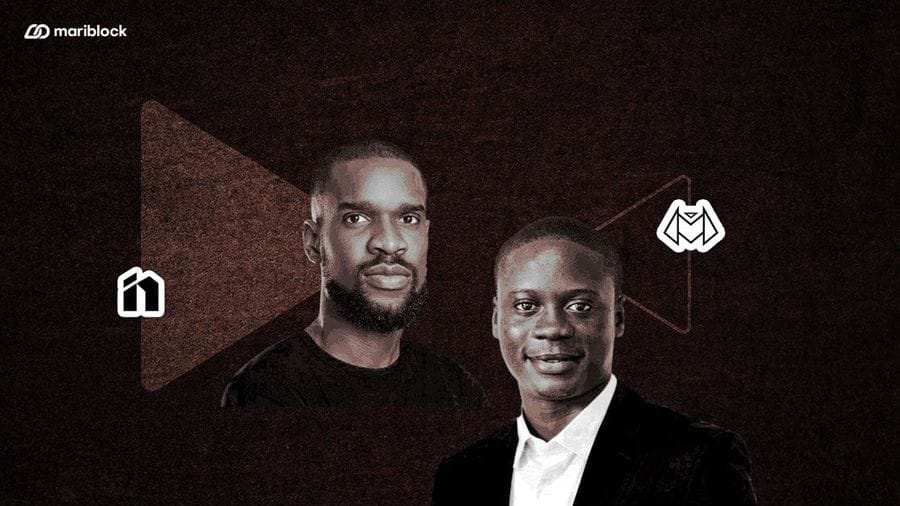
Nestcoin; Ifeoluwa Awowoye
African crypto company Nestcoin has spun off its crypto gaming project, Metaverse Magna (MVM), as part of a broader restructuring initiative. Details here
- As part of the spin-off, MVM announced the launch of Hyper, a new social gaming platform that lets gamers compete and earn rewards.
- According to the new CEO of MVM, Yemi Johnson, the guild began operations in 2021 during the Play-to-earn (P2E) craze and successfully onboarded more than 1200 scholars.
What was said: “We built Hyper to solve the problem many crypto P2E games want to fix – how to make gamers earn from a fun activity. It makes sense to solve this. Sports are fun activities, and many athletes earn from this today compared to 100 years ago. So, this is a problem worth solving because work is work,” Yemi Johnson said.
Key background: Nestcoin launched MVM in partnership with Old Fashion Research, a multistrategy blockchain investment fund.
- In September 2022, Nestcoin raised $3.2 million in a seed token sale for MVM, whose valuation at the time was $30 million.
- However, the crypto gaming market imploded the same year. This inadvertently caused the market value of leading P2E gaming projects such as Axie Infinity and Decentraland to plummet significantly.
- One factor attributed to the decline of the crypto gaming market is its instability. For instance, earning money depended on the gaming platform’s ability to attract new users, who generate demand for the existing player’s assets. That model was exposed as unsustainable when the crypto winter brought about capital flight. There was also the issue of game quality.
- MVM has now pivoted away from the popular models Axie and Decentraland.
State of play: These P2E flaws are causing crypto games to pivot.
- MVM’s learnings from the initial P2E cycle are part of what has led to its Hyper gaming platform.
- At least one other African Web3 gaming company — Afriguild — has pivoted too. Founder and CEO Toyosi Abolarin confirmed this to Mariblock via a chat. The company now goes by the name Awujo.
- Awujo has built a platform that allows traditional gamers to participate in tournaments involving games they already play.
- At this point, it’s unclear what new functionalities crypto gaming platforms bring to this market other than the ability to earn in crypto.
Why Jack Dorsey’s $30 billion empire is betting big on Africa
Credit: Block
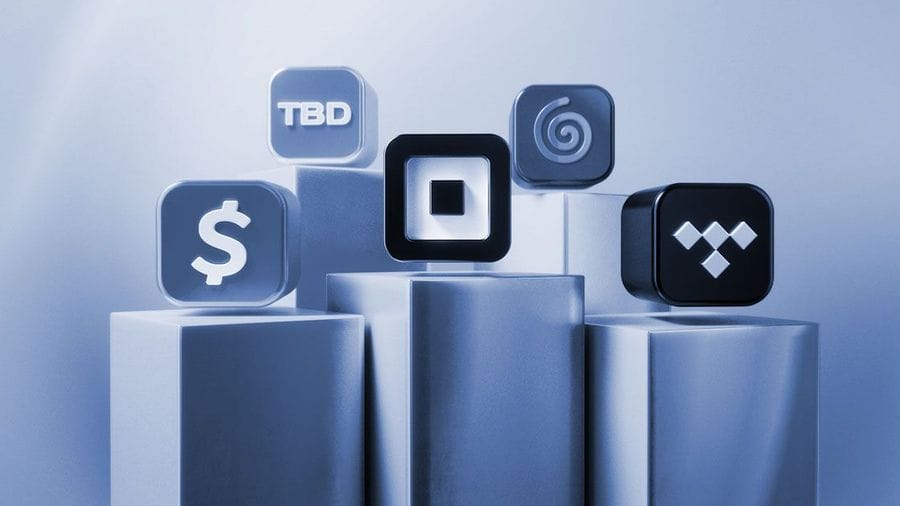
Topline: Block Inc., the Jack Dorsey-owned American payments company, is looking to countries in the so-called Global South — which refers to countries in Latin America, Asia, Africa and Oceania regions — for parts of its long-term growth. Details here
Quick facts: Block is the parent company of popular payment apps Cash App and Square.
- During Block’s first quarter earnings call on May 4, CEO Dorsey pointed out that the global financial system is “experiencing some significant shifts, from new global reserve currency candidates, centralization of banks through failure of smaller ones to [the] adoption of central bank digital currencies with entirely new capabilities.”
- Block sees these changes affecting its core business and is attempting to be proactive by focusing on three technological trends, including artificial intelligence, protocols, particularly blockchain, and the Global South.
Be smart: Block’s interest in Africa and other Global South regions appears to be a significant part of how the company plans to execute its more extensive focus on protocols.
What was said: “If we consider where the internet population will grow the fastest, we must look at the so-called Global South, countries within Africa, Latin America, Asia, and Oceania, where most of humanity resides,” Dorsey said. “This region is adopting open protocols faster than Western countries because the use cases they provide are increasingly becoming a necessity, such as money remittance.
“We are choosing to focus on these markets because we believe the total addressable market over time is bigger than anything we’re currently in. The assumption you have to make here of course is that nearly everyone in these markets has access to the internet, which is a credible one to make over the next decade.”
Dive deeper
- The partnership between Block’s subsidiary TBD and pan African exchange Yellow Card is an early indication. The partnership would see Yellow Card offer crypto-based remittance services in 16 African countries. TBD claims to have built a regulatory-compliant infrastructure that facilitates bitcoin- and stablecoin-based remittances.
- Yellow Card CEO Chris Maurice told Mariblock in an interview that TBD is looking to integrate the remittance solution across Block’s ecosystem of applications.
Of note: Dorsey hasn’t been secretive about his bullishness on Africa, particularly from the decentralization standpoint.
- His company has participated in a few venture investments in African companies such as Yellow Card, Fedi and Gridless.
Nigeria and Morocco among top 10 countries interested in meme coins

Photo by Ferhat Deniz Fors / Unsplash
Topline: African countries Nigeria and Morocco are among the hottest spots for the meme coin craze globally, according to a recent analysis by cryptocurrency tracking platform CoinGecko. Nigeria, particularly, sports a different interest profile compared to other leading markets for meme coin interest. Details here
- The report involved the analysis of the total year-to-date page views for the top 15 meme coins by market capitalization.
- Nigeria ranked fifth in the list, with meme coins like Floki and ArbDoge AI generating the highest interest at 24.2% and 20.8%, respectively. Dogelon Mars generated 17.4% of the West African country’s interest in meme coins.
Of note: Floki and ArbDoge AI both see relatively lower interests in other leading markets. The Philippines is the only other top-10 country CoinGecko mentioned to have a similar interest profile.
Critical quote: “[The data suggests] that people in the Philippines and Nigeria are also keeping an eye on the less well-known meme coins, instead of aping into those that are already trending.”
- Morocco ranked tenth, accounting for 1.2% of the total interest in meme coins. Dogecoin generated 61.1% of the country’s interest in meme coins.
Zoom out: Social media platforms like Telegram and Twitter have played a significant role in promoting and popularizing meme coins, especially in Nigeria.
- Although financial institutions are still banned from offering services to crypto accounts, citizens are not explicitly banned from trading cryptocurrencies and other digital assets.
- In Morocco, cryptocurrencies are completely banned. Flouters could face prison time and fines. Still, Morocco was the second fastest-growing market for crypto adoption in North Africa in 2022, according to blockchain analytics firm Chainalysis.
Catch up
🌍 Africa Moves to Lightning, Stablecoins as Bitcoin Transaction Fees Soar (Coindesk)
🇲🇦 France national who purchased Ferrari with bitcoin in Morocco gets an 18-month jail term (Mariblock)
🌍 Five African projects got at least $10,000 from HRF’s Bitcoin Development Fund (Mariblock)
🇿🇼 IMF and other experts caution against Zimbabwe’s adoption of gold-backed CBDC (Mariblock)
🌍 With crypto payments helping African creators, new opportunities abound (Techcabal)
🇳🇬 Nigeria’s digital currency can’t compete with crypto (Rest of World)
Unpopular opinion: Worldcoin FUD, really?
In April, our writer, Sam Adeyemo, wrote about Worldcoin’s becoming fully operational in Kenya. That story has turned out to be one of our most read ever. (Details here)
- The reason is not far-fetched. The Worldcoin project is spooky.
- Co-founded by ChatGPT creator Sam Altman, Worldcoin wants to create a digital ID for everyone (read the world’s poorest) on the blockchain using retinal scans.
- Everyone who scans their iris (a part of the eye) would qualify for crypto from Worldcoin.
- Our story highlights some of the controversies surrounding the project. (Here again)
External view: Axios’s Brady Dale points out: “For once, the mainstream and the blockchain types agree: It's kind of creepy!”
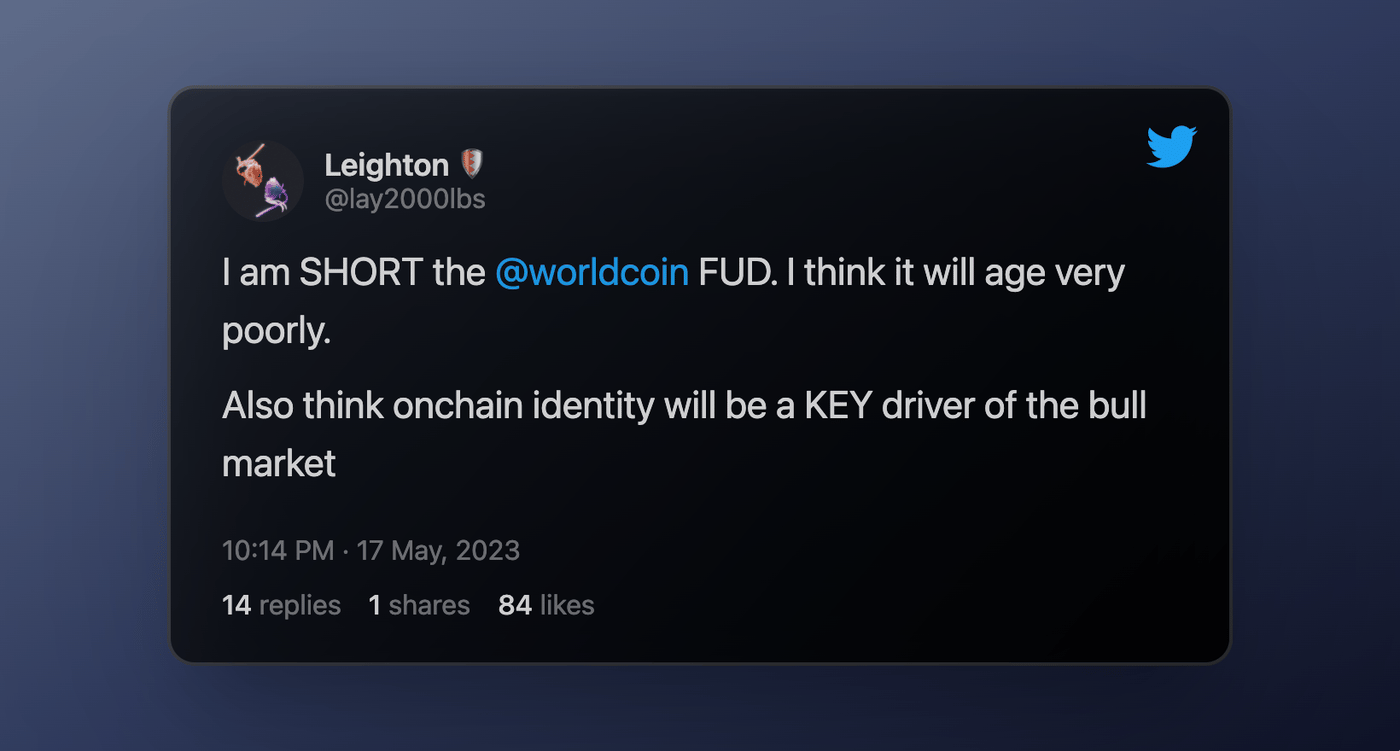
Brady’s translation: This tweet by Leighton Cusack, the creator of the lossless lottery project, PoolTogether, offers a different view.
- “Short”— He’s saying he’s betting against the skepticism.
- “FUD” — “Fear, uncertainty and doubt,” or unwarranted cynicism.