


The story behind the Nigerian SEC’s recent circular on Binance

Image: Binance | Design by Ifeoluwa Awowoye for Mariblock.
Topline: Mariblock has just published crucial details of the events surrounding the Nigerian Securities and Exchange Commission’s (SEC) June 9 circular about crypto exchange Binance. (Details)
- The circular came just after the SEC mediated a settlement between Binance and some Nigerian users who suffered losses of $994,931 trading Binance leveraged tokens (BLT).
Background: Following the initial memo, there was confusion about the company SEC referenced — “Binance Nigeria Limited” (BNL).
- Mariblock was the first to report that BNL isn’t affiliated with CZ’s Binance.
- We were also the first to report that BNL was registered for arbitrage, hoping to sell to CZ’s company if it decides to set up operations in the country and wants to use the BNL name.
- This is similar to how someone could buy the domain name “binance.ng,” hoping to sell it to Binance if the exchange ever needed it.
Still: Changpeng ‘CZ’ Zhao’ Binance resorted to deflection tactics, seeking to lead the public to believe BNL was scamming Nigerians using its name.
FYI: Mariblock has been aware of the SEC investigation into Binance since November last year when it started.
Standard Bank wants to be a follower of crypto, not a leader
Assets: Standard Bank; Getty Images | Design by Ifeoluwa Awowoye for Mariblock.
Topline: Standard Bank, Africa’s largest lender by assets, has revealed that it is watching cryptocurrency developments but will not dive into the market just yet. (Details)
- Lungisa Fuzile, the bank’s CEO for South Africa, said that the bank will be a “fast follower” once mainstream adoption kicks in but is mindful of the risks involved in cryptocurrencies.
- Standard Bank will, however, not deny services to digital asset companies, he said.
Key background: In March, Group Chief Executive Sim Tshabalala questioned the value of cryptocurrencies but claimed CBDCs could reduce financial crime and increase financial inclusion in the formal sector.
Zoom in: In South Africa, the Financial Sector Conduct Authority (FSCA) is in the process of drafting regulations for the cryptocurrency industry.
- Just recently, Mariblock reported that the FSCA mandated crypto exchanges in South Africa to obtain a license by the end of the year.
- The regulator aims to protect consumers from the risks associated with cryptocurrencies.
BTCM: Kenya’s latest crypto mining Ponzi Scheme collapses, leaving investors empty-handed
Assets: Freepik, Icons8 Photos and Billion Photos| Design by Ifeoluwa Awowoye for Mariblock
Topline: BTCM, a Kenyan-based crypto mining Ponzi scheme, has gone off the grid, taking several thousand Kenyan shillings from unsuspecting victims. (Details)
Key details: The platform told its subscribers to invest between Ksh 600 and Ksh 266,000 to purchase bitcoin mining equipment and earn as much as 188% to 350% return on investment (ROI) after a few days.
- As is typical with Ponzi schemes, most victims were invited by friends or family members.
Be smart: Crypto Ponzi schemes mainly operate identically. In most cases, they impersonate actual companies. For example, BIT Mining Limited (BTCM) is an actual Hong Kong-based crypto-mining entity with no proven affiliation to Kenya’s BTCM, which defrauded several unsuspecting Kenyans.
- Some casualties shared evidence that they were paid part of their earnings 72 hours after initiating withdrawals but could not withdraw above a certain amount daily. The 72-hour period would allow new members to invest and pay old members with the latest investment.
- The last straw came on June 27 when an administrator asked investors for a one-time KSh 6,000 deposit to rein in 300% ROI, KSh 18,000 to earn 320% ROI, 40,000 to get 335% ROI and 90,000 to get 345% ROI, all after 20 days.
- According to Mariblock sources, this was the last time anyone heard from them.
The Ponzi cycles: Ponzi and pyramid schemes are pseudo-investment schemes that pay investors with money from other investors while claiming to be involved in imaginary investment ventures.
- However, these schemes are not native to crypto, and Kenya has particularly witnessed a flurry of them over the years. In 2017, a special task force on Ponzi and pyramid schemes established that 271 different schemes existed at one point, with several complaints recorded. It is believed that many more were never reported.
Why Kenya: In a chat with Mariblock, Michael Kimani, the president of the Blockchain Association of Kenya (BAK), said these pyramid schemes are so rampant in Kenya because of a lack of consumer protection framework.
Crypto crime falls 65% in 2023 — Chainalysis
Image asset: Freepik | Design by Ifeoluwa Awowoye for Mariblock.
Topline: The first half of 2023 saw a notable decline in crypto-related crimes, with total illicit volumes plunging by 65% in the same period.
- That’s according to a new report from blockchain analytics firm Chainalysis. This is a significant decline from the two preceding years. (Details)
Key facts: Scams accounted for the most significant volume of all illicit transactions between the start of the year and June, with crypto scammers making away with little over $1 billion, about $3.3 billion less than they did in 2022.
- According to Chainalysis, the decline is driven by several factors, including the “sudden disappearance” of two large-scale scams: Vidilook and Chia Tai Tianging Pharmaceutical Financial Management.
- Other factors attributed to the decline include increased awareness of scams and improved law enforcement efforts, Chainalysis said.
Which crypto crimes are growing: Based on the report, while impersonation scams have declined by only 23% in 2023, individual transfers to impersonation scam addresses have increased by 49% year-over-year.
- This suggests that despite declining inflows, more people have fallen victim to impersonation scams in 2023.
- Ransomware is the primary crypto crime that is on the rise this year. Chainalysis finds that ransomware attackers have extorted over $449 million in 2023, which is on pace to be their second-biggest year ever.
Be smart: Ransomware is a type of malware that encrypts a victim’s files and demands a ransom payment to decrypt them.
Essential background: 2022 witnessed a decline in the average ransomware payment size due to law enforcement efforts, the availability of decrypting experts, and the adoption of improved cybersecurity and data backup practices by large organizations.
Mariblock interview: A conversation with EchoVC on its $8 million blockchain fund and the firm’s crypto thesis
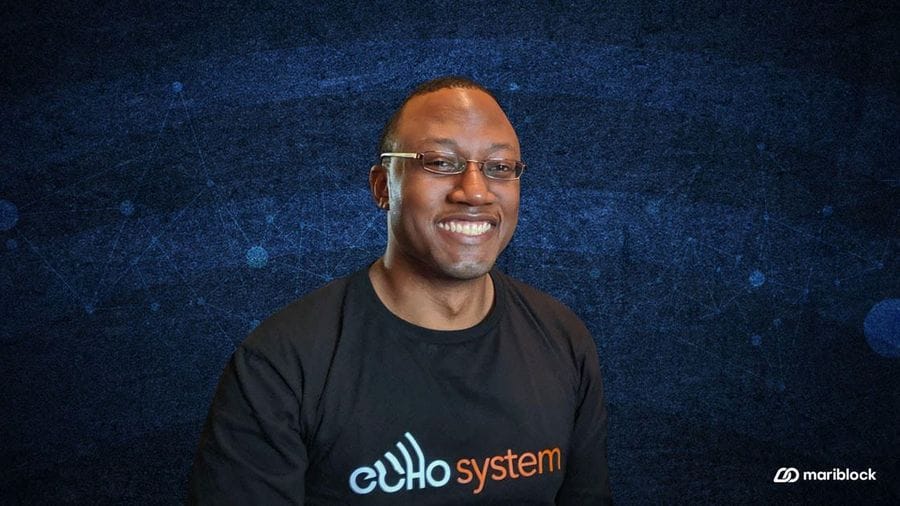
Design by Ifeoluwa Awowoye for Mariblock.
Topline: Tsendai Chagwedera, principal at EchoVC Partners, an early-stage venture capital firm that recently launched an $8 million pilot blockchain fund, sat with our lead editor, Oluwaseun Adeyanju to discuss the firm’s investment thesis and the need to solve the blockchain talent shortage. (Watch here)
- According to Chagwedera, Africa’s large youth population represents untapped potential for the blockchain industry, as a lot of infrastructure is yet to be built due to the lack of technical talent.
- He believes blockchain innovation will follow suit as talents develop and foundational infrastructure is built.
The tilt: EchoVC is generally looking to invest in startups building the infrastructure layers for the African blockchain industry.
- For example, EchoVC believes there’s an opportunity for edtech firms to develop Africa’s blockchain talent pipeline. (Watch here)
Mariblock
Catch up
🌍 IMF warns that unregulated cryptocurrencies could threaten financial stability (Read here)
🇳🇬 Bundle Africa shuts exchange operations after three years (Techcabal)
🌍 Telegram merchants can now accept crypto payments with a new in-app feature (Read here)
🇳🇬 Central Bank of Nigeria upgrades eNaira with NFC feature (Read here)
🇿🇼 Economist urges Zimbabwean government to consider paying civil workers in gold (Read here)
🇳🇬 Nigeria’s oil sector looking to attract billion-dollar FDI (Read here)
🇹🇿 Tanzania secures $195 million budget support from the EU (Read here)
🇳🇬 WorldRemit expands Nigerian remittance services to include naira payouts (Read here)
I’d love to hear from you ✍🏾
What are your thoughts about this newsletter?
What are we doing well, and what should we improve on?
Hit the reply button, and let’s talk — even if it’s a reaction to any of the stories covered here.
I look forward to hearing from you.
That’s it for this week.
See you next week.
Cheers,
Ogechi.