

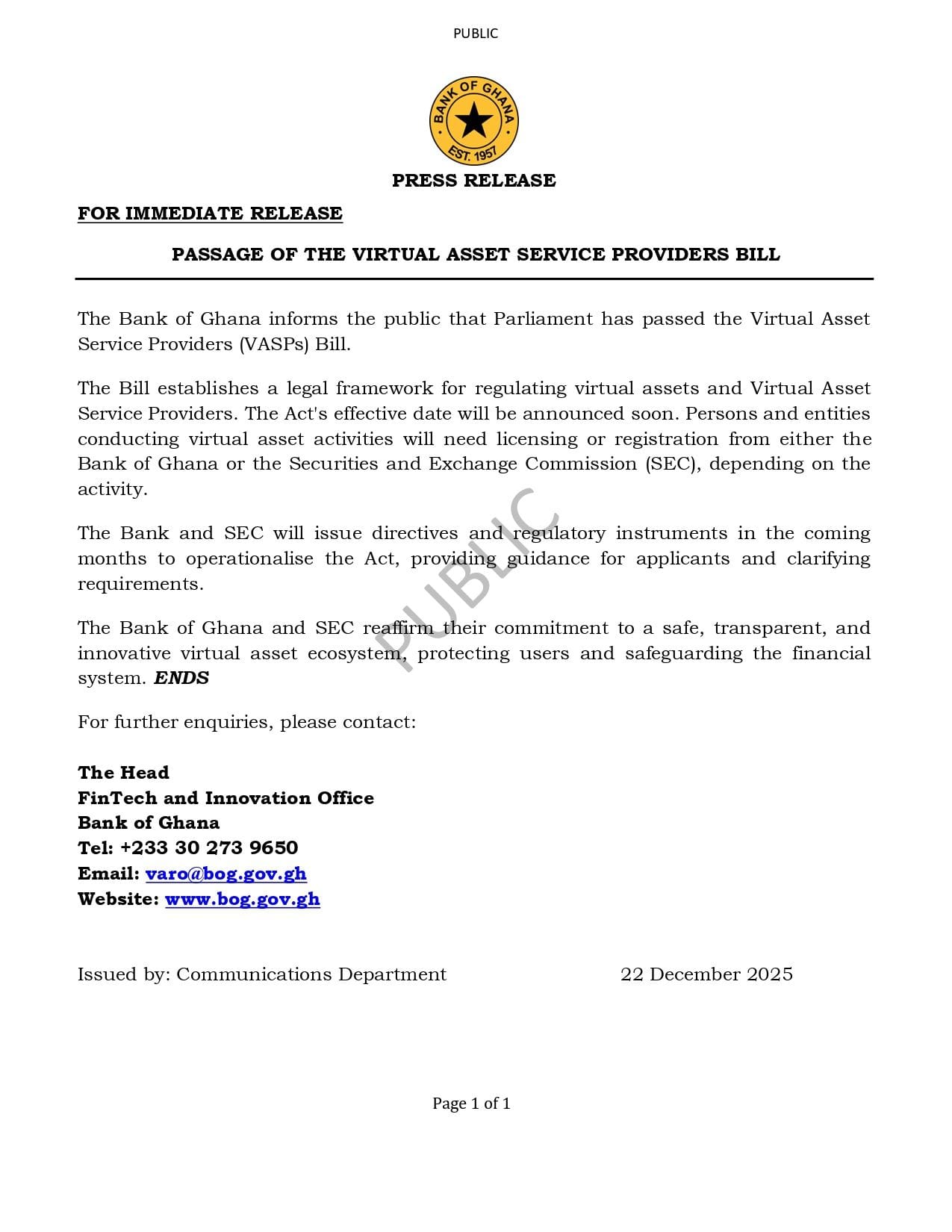
In a Dec. 22 notice, the Bank of Ghana said Parliament had passed the Virtual Asset Service Providers Bill, establishing legal oversight for crypto assets and related businesses. Firms will be required to meet licensing and compliance requirements once the law takes effect.
Quick facts
Crypto activity is now explicitly recognized in law, ending years of legal uncertainty around the industry in Ghana.
- Digital asset service providers will be required to obtain a licence or register with either the Bank of Ghana or the Securities and Exchange Commission, depending on the nature of their activities.
- Oversight will be activity-based, with responsibilities split between the central bank and the capital markets regulator.
- The law has been passed but is not yet in force, with its effective date to be announced.
- The Bank of Ghana and the SEC say they will issue directives and regulatory instruments in the coming months to operationalize the Act.
Key quote
“The Bill establishes a legal framework for regulating virtual assets and Virtual Asset Service Providers,” the Bank of Ghana said, adding that it is committed to “a safe, transparent, and innovative virtual asset ecosystem, protecting users and safeguarding the financial system.”
Before now
Ghana’s approach to crypto has long been cautious, shaped more by warnings than enforceable rules.
- Mariblock has previously reported that authorities discouraged regulated financial institutions from engaging with crypto and stressed that digital assets were unrecognised by law. Even as usage expanded, regulation lagged.
Regulators later began laying groundwork without a firm legislative base.
- In 2023, the finance ministry reiterated that Ghana’s cryptocurrency ban remained in effect, warning the public and financial institutions against crypto exposure.
- Despite that stance, the Bank of Ghana moved to quietly prepare for regulation, issuing draft guidelines on digital assets and calling on virtual asset service providers to register as it built a clearer picture of market activity.
- In parallel, the Securities and Exchange Commission set up an internal committee to study crypto markets and develop regulatory capacity ahead of formal legislation.
Of note
As of June 2024, global regulators were still warning that crypto oversight lagged behind adoption.
- A Financial Action Task Force review found that most jurisdictions, including across Africa, had yet to fully implement anti-money-laundering (AML) standards for virtual assets.
- Regulatory efforts in several markets have since accelerated alongside broader global pressure to align with FATF standards.
Zoom out
Ghana’s move comes as more African countries formalize rules for crypto activity.
Several jurisdictions have passed or proposed laws to regulate digital assets and related service providers, typically covering licensing, supervision and anti-money-laundering requirements.
- In Nigeria, digital assets fall under the Securities and Exchange Commission (SEC) following updates to securities law.
- Kenya’s framework places oversight with the Central Bank of Kenya (CBK) and the Capital Markets Authority (CMA).
- South Africa regulates crypto asset service providers through the Financial Sector Conduct Authority (FSCA) under existing financial laws.
Ghana’s Virtual Asset Service Providers Bill places the country among African markets with a legislative basis for regulating crypto-related activity, with oversight shared between the Bank of Ghana and the Securities and Exchange Commission.